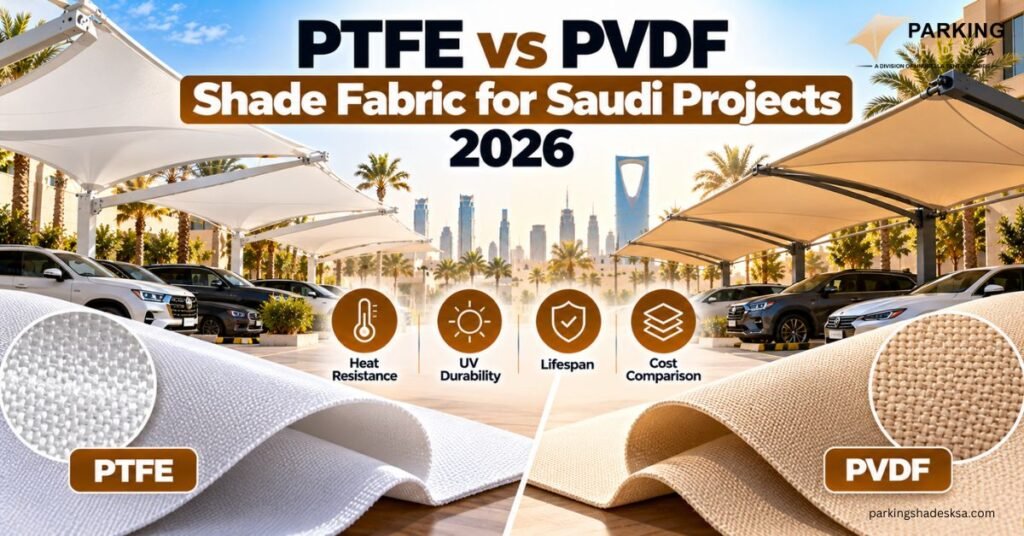
By Parking Shades KSA Team | Published September 24, 2026
PTFE is the top-tier choice for landmark, long-life structures where budget allows. PVDF-coated fabric is the practical choice for most commercial shades that need a clean, weatherproof membrane at a lower cost. That’s the headline of any PTFE vs PVDF shade fabric for Saudi projects decision. The detail, which covers heat, dust, fire, handling and cost, is what this article explains so you can specify with confidence.
Quick Answer at a Glance
Here’s how the two membranes compare on the points that matter in Saudi Arabia.
| Point | PTFE membrane | PVDF-coated fabric |
|---|---|---|
| What it is | Woven glass fiber coated with PTFE | Polyester base coated with PVC and a PVDF topcoat |
| Service life | The longest of common membranes | Long, though shorter than PTFE |
| Dirt resistance | Very high, rain washes it clean | Good, better than plain PVC |
| Flexibility | Stiff, needs careful handling | Flexible, easier to fold and fit |
| Fire behavior | Glass base does not burn | Depends on the product’s fire rating |
| Cost | Highest | Moderate |
| Typical use | Landmark roofs, stadiums, large canopies | Commercial canopies, walkways, car parks |
What Is PTFE Shade Fabric?
PTFE membrane: a woven fiberglass fabric coated with PTFE (polytetrafluoroethylene, the same family of material as non-stick coatings).
The glass base is very strong and doesn’t burn. The PTFE coating resists UV, chemicals and dirt. Dust and sand don’t stick easily and rain washes most of it away. One of the best-known uses in the Kingdom is the Hajj Terminal at King Abdulaziz International Airport in Jeddah, whose famous tent roofs are made from PTFE-coated glass fabric.
PTFE has limits. It’s stiff and can crack if folded sharply. It must be handled and installed by experienced crews. It’s also the most expensive common membrane.
What Is PVDF Shade Fabric?
PVDF-coated fabric: a polyester base coated with PVC, then finished with a thin PVDF (polyvinylidene fluoride) lacquer on top.
The PVDF topcoat makes the surface smoother and more resistant to UV and dirt than plain PVC. The polyester base keeps the fabric flexible. That makes it easier to cut, weld, fold and install. It’s widely used for commercial tensile canopies, walkways and car park shades that need to be waterproof.
In trade talk, “PVDF membrane” usually means this PVC-coated polyester with a PVDF finish. It isn’t a solid sheet of PVDF.
PTFE vs PVDF Shade Fabric for Saudi Projects: Six Deciding Factors
Every project comes down to the same six questions. Answer them in order.
1. How long must the structure last?
For a landmark building meant to stand for decades, PTFE’s long life can justify the cost. For a commercial car park or canopy with a normal design life, PVDF-coated fabric is usually enough.
2. How dusty is the site?
Saudi sites are dusty almost everywhere. PTFE sheds dust best. PVDF-coated fabric is next. Plain PVC collects more dirt and needs more cleaning. On a site where cleaning access is difficult, the self-cleaning surface of PTFE is a real advantage.
3. What are the fire requirements?
Public buildings, hospitals and airports often have strict fire rules. PTFE’s glass base doesn’t burn. PVDF-coated fabrics are available with fire ratings. Each product must still be checked. The General Directorate of Civil Defense and the Saudi Building Code (SBC 801 is the fire code) set the rules. Your consultant will name the class needed.
4. How complex is the shape?
Complex, double-curved shapes are possible with both. PVDF-coated fabric is more forgiving during fabrication and installation. PTFE needs more precise patterning and careful handling.
5. What’s the budget?
PTFE costs more for material, fabrication and installation. PVDF-coated fabric gives a good balance of look, performance and price for most commercial work.
6. Is shade or full weather cover needed?
Both are waterproof. If you only need shade with airflow, neither may be the best fit. Breathable HDPE is lighter and more economical for open car parks. Compare it on our HDPE parking shades page.
Where Each Membrane Fits in Saudi Projects
The table matches common project types with the membrane we’d usually shortlist.
| Project type | Usual first choice | Reason |
|---|---|---|
| Landmark roof or stadium canopy | PTFE | Longest life, self-cleaning, strong fire performance |
| Hotel or mall entrance canopy | PVDF-coated fabric | Clean look, waterproof, moderate cost |
| Hospital drop-off or walkway | PVDF-coated or PTFE (per fire rating) | Weather cover plus fire compliance |
| Open staff or visitor car park | HDPE | Breathable, economical, easy to replace |
| Coastal industrial canopy | PVDF-coated fabric on well-coated steel | Weather cover with manageable cost |
How to Write a Membrane Specification
A clear specification saves arguments later. These are the points a consultant or buyer should fix in writing.
- Name the membrane type: PTFE-coated glass or PVDF-coated polyester
- State the fire class required and ask for the test report
- Ask for the manufacturer’s datasheet with weight, strength and coating details
- Set the color and light transmission you want
- Define the design life and the warranty terms for membrane and frame
- Require factory welding and a patterning check before cutting
- List the cleaning and inspection routine expected after handover
With these seven points written down, quotes can be compared fairly.
Mistakes to Avoid When Specifying Membranes
Don’t choose by name alone. Two products sold as “PVDF” can have different base fabrics, coatings and fire ratings. Ask for the datasheet and the fire test report.
Also look past the fabric to the frame. A high-grade membrane on a poorly coated steel frame will look tired within a few seasons. In coastal cities such as Dammam, Jubail and Jeddah, the steel coating is just as important as the fabric.
And don’t forget maintenance access. (Even self-cleaning membranes need an inspection now and then.)
How Parking Shades KSA Specifies Membranes
We work with HDPE, PVC, PVDF and PTFE, combined with galvanized or powder-coated steel frames. Each project starts with a free survey and a discussion of design life, fire rules, budget and look. The fabric and frame are then proposed to fit those needs. Our shade structure products page lists every material we supply.
Industrial clients such as Saudi Aramco, SABIC and Alfanar have trusted our team on demanding sites. For industrial car parks, see our industrial cantilever parking shades article.
Recommended Shade Solutions by Membrane Need
We don’t yet have separate pages for PTFE and PVDF membrane structures. Ask our team for membrane options. These three product lines cover related needs.
PVC Parking Shades
PVC parking shades are long-lasting and need minimal maintenance. The durable, flexible fabric suits hotels, office complexes and commercial parking. They’re a practical option where full weather cover is needed at a lower cost than PTFE or PVDF membranes. View PVC parking shades.
HDPE Parking Shades
HDPE is a breathable fabric that gives long-lasting protection against UV, rain and strong winds. It’s the economical choice for open car parks where airflow matters more than full rain cover. See HDPE fabric shade structures.
Sail Shades
Sail shades use tensioned fabric panels between fixing points. They can be made in different fabrics depending on the project and suit landscaped spaces, entrances and seating areas. Explore sail shades.
Choosing Your Membrane
PTFE vs PVDF shade fabric for Saudi projects comes down to design life, dust, fire rules, shape and budget. PTFE leads on life and self-cleaning. PVDF-coated fabric leads on value and flexibility. For open car parks, HDPE often beats both. Start with our HDPE parking shades or ask us for a membrane proposal.
About the Author
Parking Shades KSA Team.
Frequently Asked Questions
Is PTFE the same as Teflon?
PTFE is the chemical name of the material best known under the Teflon brand. In shade structures it’s used as a coating on woven glass fiber. The glass gives strength and the PTFE gives a surface that resists dirt, UV and chemicals.
Can PVDF-coated fabric be welded on site?
PVDF-coated fabric is normally welded in the factory where heat and pressure can be controlled. Small repairs can be made on site with the right tools. The PVDF topcoat can make welding harder. The edges are usually prepared before joining.
Does PTFE get hot under the Saudi sun?
PTFE membranes are usually light in color and reflect a large share of sunlight. Some light passes through, which gives a soft daylight glow underneath. The space below still benefits from shade and airflow if the sides are left open.
Is PVDF better than plain PVC?
For most outdoor uses, yes. The PVDF topcoat improves UV and dirt resistance. The fabric stays cleaner and looks better for longer. Plain PVC costs less but collects more dirt. The right pick depends on budget and how visible the structure is.
Can a car park use PTFE?
It can. PTFE is more often chosen for landmark canopies than for everyday car parks because of cost. Most car parks use HDPE or PVC-based fabrics. A PTFE car park canopy makes sense where the structure is also an architectural feature.
How should membranes be cleaned?
Gently. Use water and a soft brush or low-pressure rinse. Avoid harsh chemicals and high-pressure jets that can damage coatings. A yearly inspection with cleaning keeps any membrane in good shape.